






 How to Win Hyperscaler Marketplaces
 Create a ROI-Driving Partner Experience
The AI-Driven GTM Operating Model: How Ecosystems Will Scale in the Next Decade
Go-to-market (GTM) planning used to resemble following a printed map: setting the route once and trying to stick to it despite shifting conditions.
Teams would define the path at the beginning of the year, distribute those plans across sales, marketing, and partners, and then spend the next twelve months trying to follow them, even as markets shifted, buyers changed direction, and new obstacles appeared. When performance slipped, organizations stopped, reassessed, recalculated, and issued updated instructions.
That approach no longer works.
Modern partner ecosystems operate more like global transportation networks than fixed roadways. Demand signals change daily. Partner performance fluctuates. New channels open while others close. In this environment, growth is no longer about choosing the right route. It requires constant awareness and real-time adjustment.
This is where the AI-driven growth operating model emerges. AI transforms planned market activities from a set of scheduled tasks into a dynamic system that senses change, predicts opportunity, and coordinates execution across the entire ecosystem.
From Static Planning to Live Navigation
Traditional GTM planning assumes stability: define the plan, execute the plan, and review the plan. But ecosystems are anything but stable. Research from Forrester shows that organizations often deploy AI in isolated pockets rather than as part of a unified strategy. This fragmented approach can limit visibility and reduce impact, emphasizing the need for an integrated, adaptive AI operating model to guide teams and partner ecosystems effectively.
The AI-driven model replaces static planning with continuous, data-driven decision-making. Every interaction, transaction, and engagement becomes a signal. AI processes these signals at scale and turns them into actionable insights, not quarterly adjustments, but moment-to-moment optimization.
Instead of asking, “Are we following the plan?” leaders begin asking, “Are we steering through the market as it actually exists today?”
This shift fundamentally changes how partner programs operate. Growth becomes adaptive. Risk becomes predictable. Opportunity becomes visible earlier. Execution becomes coordinated across the entire ecosystem, with vendors, partners, and internal teams working in sync with shared awareness of their current position and next steps.
Why Ecosystems Demand AI-Led Orchestration
Partner ecosystems amplify the GTM complexity. Every new partner, region, incentive model, and co-selling motion adds new intersections to the map. Managing that environment with manual processes is like trying to traverse a megacity with printed directions.
Without AI, organizations try to compensate by adding more people, spreadsheets, and disconnected tools. The result is slower movement, inconsistent partner experiences, and limited insight into what drives revenue. According to a recent finding from KPMG LLP, 83% of large enterprises are expanding their partner ecosystems to accelerate growth, reflecting the increasing scope and sophistication of managing these networks. These findings confirm that while ecosystem-driven growth is real, orchestrating it effectively has become a significant challenge.
AI addresses this multi-layered network by serving as the control center of the ecosystem. It continuously monitors conditions, coordinates motion, and keeps vendors, partners, and internal teams aligned and informed. By converting every interaction, transaction, and signal into actionable guidance, AI ensures that teams can act confidently and adapt in real time.
Over the long term, three milestones will define this transformation:
- Continuous Navigation: GTM decisions shift from periodic reviews to constant optimization driven by live data.
- Autonomous Execution: Onboarding, content delivery, deal management, and partner operations increasingly execute through intelligent automation.
- Predictive Growth: AI models anticipate partner success, identify risks early, and recommend actions before outcomes are lost.
None of this works without trust. As AI plays a central role in guiding the ecosystem, governance, security, compliance, and data integrity must be built directly into the system. These serve as the rules of the road, keeping every participant safe, aligned, and confident.
How Impartner Is Building the Navigation Layer with Aimi
At Impartner, we recognized that generic AI tools and surface-level chatbots are not equipped for this journey. Partner ecosystems require AI that understands the terrain, the traffic, the rules, and the destination.
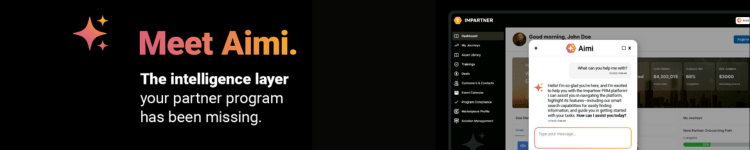
That is why we built Aimi (Artificial Impartner Intelligence), an AI engine embedded directly into the Impartner platform and designed specifically for partner revenue orchestration.
Aimi functions as the navigation layer of the partner ecosystem, delivering four critical capabilities:
- Intelligent Task Automation: Aimi removes friction from daily partner operations, automating high-value work such as content creation, translation, and natural-language deal registration through text or voice, allowing teams to move faster with fewer obstacles.
- Context-Aware Guidance: By understanding partner type, tier, region, permissions, and program rules, Aimi delivers precise, personalized guidance. It does not offer generic directions; it provides tailored instructions for the exact conditions each partner faces.
- Seamless Workflow Integration: Because Aimi is built into the Impartner platform, it preserves data integrity, validates required fields, applies custom logic, and completes workflows accurately. This enables AI to act directly instead of only providing suggestions, keeping the entire ecosystem on course.
- Instant, Actionable Insights: By indexing content and analyzing partner behavior, Aimi surfaces hidden patterns, identifies content gaps, and reveals where partners struggle, enabling continuous improvement across the journey.
The result is an ecosystem that moves with greater speed, higher confidence, and measurable revenue impact.
The Decade Ahead
GTM is no longer about drawing better maps; it’s about maintaining direction and staying coordinated as conditions evolve.
The organizations that scale in the next decade will not simply use AI. They will redesign their entire operating model around AI as the orchestration layer that connects decisions, execution, and growth across distributed partner networks.
With Aimi, Impartner is helping customers make that shift today by providing the insight, guidance, and operational control required to move through constant change with confidence and trust.